JavaSE
Getting Started
An introduction to Java technology and lessions on installing Java development software and using it to create a simple program.
The Java Technology Phenomenon
Java technology is both a programming language and a platform. (java即是编程语言也是平台)
The java Programming Language
The Java programming language is a high-level language that can be characterized by all of the following buzzword.
- Simple
- Architecture neutral (平台无关的)
- Object oriented
- Portable (可移植的)
- Distributed (分布式的)
- High performance
- Multithreaded
- Roubust (健壮的)
- Dynamic
- Secure
MyProgram.java – javac –> MyProgram.class – java –> MyProgram
Through the Java VM, the same application is capable of running on multiple platforms.
The java platform
A platform is the hardware or software environment in which a program runs.
The Java platform has two components:
- The Java Virtual Machine.
- The Java Application Programming Interface(API).
JVM 是java平台的基础,并被移植到各种给予硬件的平台上。
The API is a large collection of ready-made(现成) software componment that provide many useful capabilities(功能). It is grouped into libraries of related classes and interfaces; these libraries are known as packages.
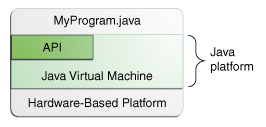
The API and Java Virtual Machine insulate the program from the underlying hardware.
What Can Java Technology Do?
- Development Tools: The development tools provide everything you’ll need for compiling, running, monitoring, debugging, and documenting your application. As a new developer, the main tools you’ll be using are the javac compiler, the java launcher and the javadoc documentation tool.
- Application Programming Interface(API): The API provides the core functionlity of the java programming language.
- Deployment Technologies
- User Interface Tookit
- Integration Libraries: Integration libraries such as the Java IDL API, JDBC API, Java Naming and Directory Interface(JNDA) API, and Java Remote Method Invocation over Internet Inter-ORB Protocol Technology (Java RMI-IIOP Technology) enable database access and manipulation of remote objects.
How Will Java Technology Change My Life?
Learning the Java language
Lessons describing the essential concepts and features of the Java Programming Language.
This trail provides everything you’ll need to know about getting started with the Java programming language.
Object-Oriented Programming Concepts
teaches you the core concepts behind object-oriented programming: objects, messages, classes and inheritance. The lesson ends by showing you how these concepts translate into code.
What Is an Object?
Software objects are conceptually similar to real-world object: they too consist of state and related behavior. An object stores it state in fields(variables in some
programming languages) and exposes its behavior through methods (functions in some programming languages).Methods operate on an object’s internal state and serve as
the primary mechanism for object-to-object communication. Hiding internal state and requiring all interaction to be performed through an object’s methods is know asdata encapsulation(数据封装) – a fundamental principel of object-oriented programming.
Bundling code into individual software objects provides a number of benefit, include:
- Modularity: The source code for an object can be written and maintained independently of the source code for other objects. Once created, an object can be easily passed around inside the system.
- Information-hiding: By interacting only with an object’s methods, the datails of its internal implementation remain hidden from the outside world.
- Code re-use: If an object already exists (perhaps written by another software developer), you can use that object in your program. This allows specialists to implement/test/debug complex, task-specific objects, which you can then trust to run in your own code.
- Pluggability and debugging easy: If a particular object turns out to be problematic, you can simple remove it from your application and plug in a different object as its replacement.This is analogous to fixing mechanical problems in ther real world. If a bolt breaks, you replace it, not the entire machine.
What Is a Class?
A class is the blueprint from which individual objects are created.
What Is Inheritance?
Object-Oriented programming allows classes to inherit commonly used state and behavior from other classes.In the Java programming language, each class is allowed to have one direct superclass, and each superclass has the potential for an unlimited number of subclass.(java 是单继承的)
What Is an Interface?
Interface form a contract between the class and the outside world, and this contract is enforced at build time by the compiler. If your class claims to implement an interface, all methods defined by that interface must appear in its source code before the class will successfully compile.
Note: To actually compile the ACMEBicycle class, you’ll need to add the public keyword to the beginning of the implemented interface methods.
What Is a Package?
A package is a namespace that organizes a set of related classes and interface.(因为java开发的软件由成千上万的类文件组成,将关联类和接口放在同一特定意义的包中)
Language Basics
describes the traditional features of the language. include variables, array, data types, operators and control flow.
Variables
You’ve already learned that objects store their state in fields. However, the Java programming language also uses the term “variales” as well. This section discusses this relationshi, plus variable naming rules and conventions, basic data types (primitive types, character strings, and arrays), default value, and literals(文字).1
2
3
4
5Q:
What are the rules and conventions for naming a field?
Besides int, what other data types are there?
Do fields have to be initialized where they are declared?
Are fields assigned a default value if they are not explicitly initialized? # 如果未明确初始化字段,为字段分配默认值吗?
We’ll explore the answers to such questions in this lesson.
The Java programming language defines the following kinds of variables:
Instance Variables (Non-Static Fields): Technically speaking, object store their individual states in ‘non-static fields’, field declared without the
statickeyword. Non-static fields are also know as instance variables because their values are unique to each instance of a class (to each object, in other words); thecurrentSpeedof one bicycle is independent from thecurrentSpeedof another.Class Variables (Static Field): A class variable is any field declared with the
staticmodifier, this tells the compiler that there is exactly one copy of the variable in existence, regardless of how many times the class has been instantiated. The codestatic int numGears = 6;would create such a static field. Additionally, the keywordfinalcould be added to indicate that the number of gears will never change.Local Variables: Similar to how an object stores its state in fields, a method will often store its tempoary state in
local variable. The syntax for declaring a local variable is similar to declaring a field(for exampleint count = 0). There is no special keyword designating a variable as local. that determination comes entirely from the location in which the variable is declared – which is between the opening and closing braces of the method. As such, local variables are only visible to the methods in which they are declared; they are not accessiable from the rest of the class.Parameters: You’ve already seen examples of parameters, both in the
Bicycleclass and in themainmethod of the “Hello World!” application.Recall that the signature for the main method ispublic static void main(String[] args). Here, the args variable is the parameter to this method.This applies to other parameter-accepting constructs as well (such as constructors and exception handlers) that you’ll learn about later in the tutorial.
Naming
- 大小写敏感,以
字母,$, _开头(通常都是使用字母开头,避免使用$和_) - 后续字符可以是
字母,$,_ 和数字,不能使用关键字和保留字 - 小驼峰命名;常量的话,使用大写加下划线的形式命名,例:
final int NUM_GEARS = 6
Primitive Data Types
The Java Programming language is statically-typed, which means that all variables must first declared before they can be used.This involives stating the variable’s type and name, as you’ve already seen:
本文作者 : Xuebin Zhang
原文链接 : https://capping.github.io/2018/08/08/JavaSE/
版权声明 : 本博客所有文章除特别声明外,均采用 CC BY-NC-SA 4.0 许可协议。转载请注明出处!